Glossary
Generator Glossary
The terms you meet in generator quotations and datasheets, explained briefly.
- Alternator
- The part of the generator that turns engine rotation into electricity. JERBINDO generators use alternator brands such as Stamford and Leroy Somer.
- AMF (Automatic Mains Failure)
- A control panel function that detects a mains failure, starts the generator automatically and, together with the ATS, transfers the load.
- ATS (Automatic Transfer Switch)
- A switch that moves the load from the grid to the generator during an outage, then back to the grid once supply returns.
- AVR (Automatic Voltage Regulator)
- A regulator that keeps the alternator output voltage stable as the load changes.
- Commissioning
- The tests after installation that confirm the generator, panels and supporting systems work to specification before handover.
- Continuous power
- Power for a constant load that runs without a limit on operating hours. The power calculator adds extra margin for this duty.
- Power calculator
- Derating
- A reduction in generator capacity when site conditions fall outside standard conditions, for example high room temperature or an altitude above 1000 m.
- How altitude affects generators
- kVA (kilovolt-ampere)
- The unit of apparent power. Generator capacity is stated in kVA because the alternator must supply current for both active and reactive load.
- Estimate the kVA you need
- kW (kilowatt)
- The unit of active power that equipment actually uses. kW = kVA × power factor; a 500 kVA generator at a power factor of 0.8 delivers 400 kW.
- Choosing a generator
- Load bank
- An artificial load used to test a generator at a set capacity, for example during commissioning or routine maintenance.
- N+1 redundancy
- A configuration with one more unit than the load needs, so power stays available when one unit fails or is under maintenance.
- Why redundancy matters
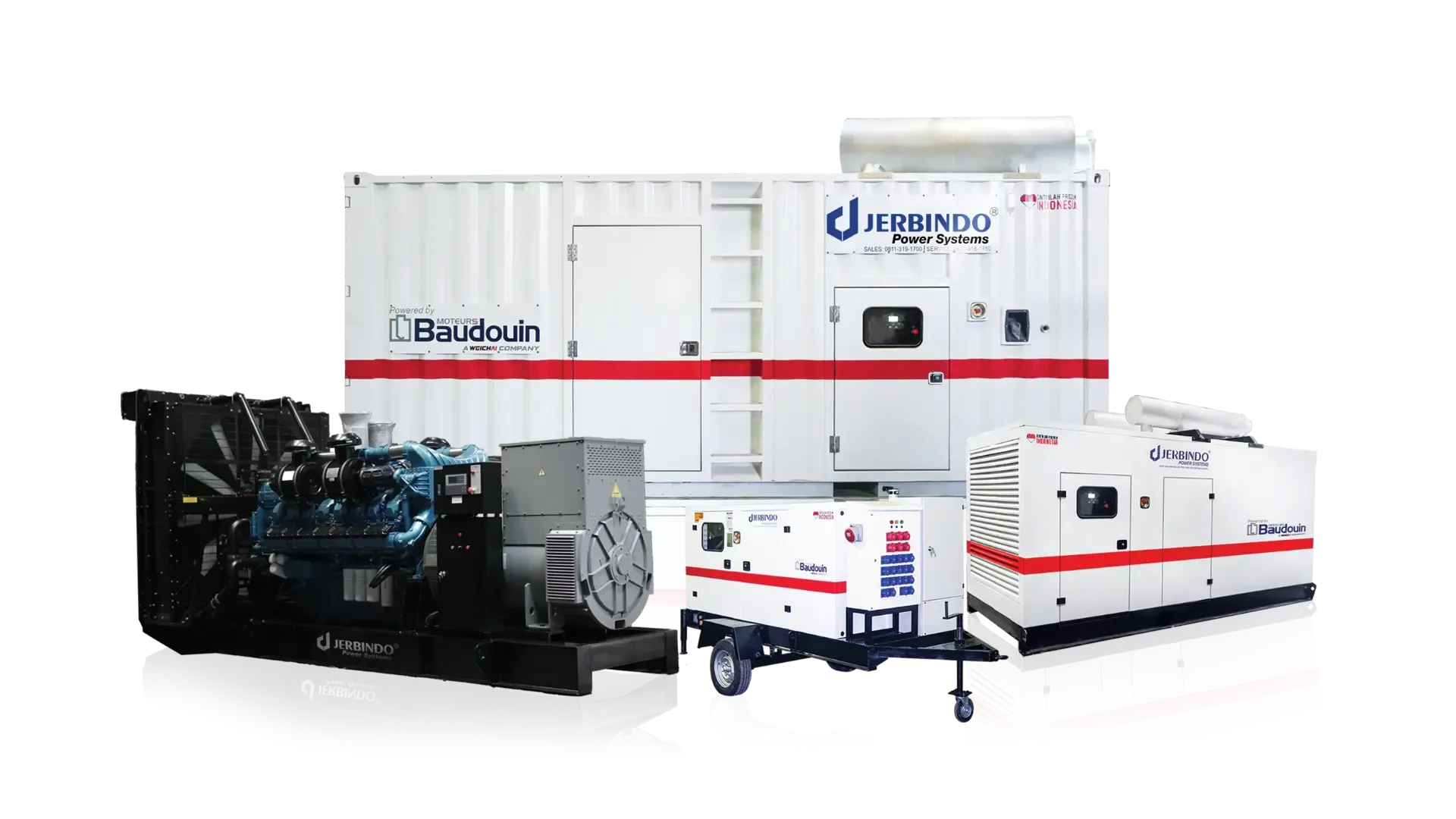
- Open type generator
- A generator without a sound-attenuating canopy. It is installed in a dedicated generator room that provides ventilation, exhaust routing, weather protection and sound control.
- Open type generators
- Power factor
- The ratio of active power (kW) to apparent power (kVA). Generator ratings are usually stated at a power factor of 0.8.
- Prime power (PRP)
- The maximum power for unlimited running hours with a varying load, for example when the generator is the main power source. The average load over 24 hours should not exceed 70% of the prime rating.
- See prime ratings in the catalogue
- Silent canopy
- A sound-attenuating enclosure that lowers noise and protects the unit from the weather, so the generator can be installed outdoors.
- Silent type generators
- Silent container
- A container-type enclosure for large generators. JERBINDO offers it from 750 kVA.
- 1000 kVA generators
- Standby power (ESP)
- The maximum power for backup during a mains failure, with limited running hours per year and no overload capability. It is usually about 10% above the prime rating.
- Starting current
- The current an electric motor draws as it starts, several times its running current. It drives generator sizing for motor loads.
- Calculating backup power
- Synchronizing panel
- A panel that matches the voltage, frequency and phase of two or more generators so they can run in parallel and share the load.
- TKDN (local content level)
- The local content value of a product, required in Indonesian government and state-owned procurement. JERBINDO and VOLTRAGEN products are TKDN certified and listed on e-Katalog.
- About the company